
Are You Looking at The Right Marketing Metrics? Here’s What Industry Leaders Are Measuring

From campaign performance and website traffic to social media engagement and conversion, tracking your marketing efforts involves many moving parts.
While these data points can provide valuable insights, it can also be easy to lose sight of what’s important.
In fact, only 23% of marketers are confident they’re tracking the right marketing metrics.
That’s where they start making wrong decisions, strategies become reactive, and budgets get stretched, which can make marketing feel less effective. This article dives into what the experts are doing and tracking to measure marketing effectiveness and drive business success.
Why Marketing Metrics Matter
Marketing metrics give you clarity on what’s actually working and what isn’t. Without them, decisions are based on assumptions instead of evidence.
The right metrics connect marketing efforts to real business outcomes, like revenue growth and customer acquisition. They help you spot opportunities and fix underperforming areas quickly, so you can grow your business with confidence.
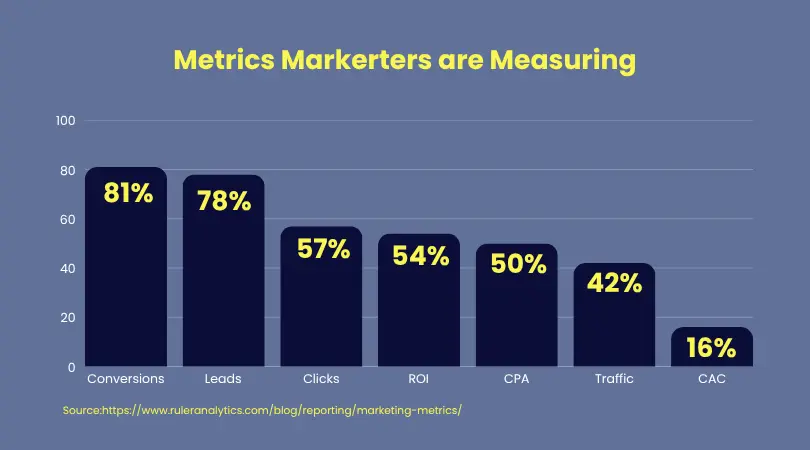
Top Metrics Industry Leaders are Measuring
Return on marketing investment (ROMI)
Return on marketing investment (ROMI) is a metric that can provide crucial insight into the projected and actual results of marketing initiatives.
It essentially tells you how much revenue your marketing is generating relative to what you’re spending, and whether it’s worth it.
ROMI also analyses the customer journey in the decision stage. It compiles profit-related information into a single metric that helps communicate overall performance and impact.
When you’re measuring ROMI, you can:
- Prioritise high-performing campaigns.
- See where to scale and where to stop wasting budget.
- Connect marketing directly to business growth.
Conversion rate
Conversion rate is the percentage of digital visitors who take a desired action on your website or platform.
It’s one of the most important metrics in the consideration stage of the customer journey.
Understanding your conversion rate is important because it focuses on your customers’ actions.
A higher conversion rate indicates better engagement with your target audience. On the other hand, a lower conversion rate suggests you might need to find new ways to engage customers and prompt them to take action.
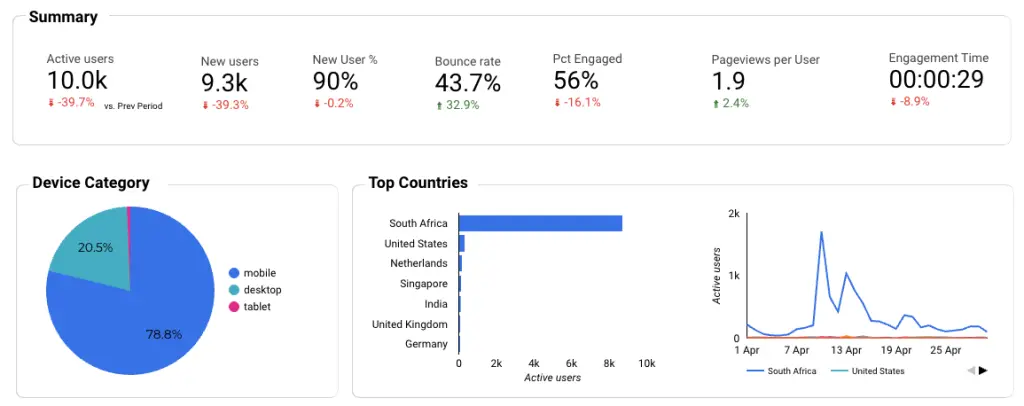
You can measure conversion rate using digital tools like Google Analytics that track user interactions and behaviour.
Engagement rate
Before a customer buys anything, they must first care about what you’re selling.
Your engagement rate goes beyond impressions and reach, measuring how your audience is actually interacting with your content.
This includes clicks, shares, comments, and time spent engaging with your brand.
For leaders, this is less of a vanity metric and more about relevance. Strong engagement indicates that your messaging resonates with your audience and that you are building meaningful connections.
It’s also an early indicator of future performance. Content that drives engagement is far more likely to contribute to conversions and long-term brand loyalty.
Lead-to-customer rate
Generating leads is only one part of the equation. What really matters is how many of those leads become customers.
The lead-to-customer rate measures the effectiveness of your entire funnel, from initial interest to final conversion. It highlights both the quality of the leads being generated and how well marketing and sales are working together.
A low conversion rate from leads to customers often points to misalignment, such as the wrong target audience, unclear messaging, or gaps in the sales process.
Industry leaders prioritise this metric because it directly impacts revenue. Improving it means getting more value from the leads you already have instead of constantly chasing new ones.
Search engine rankings
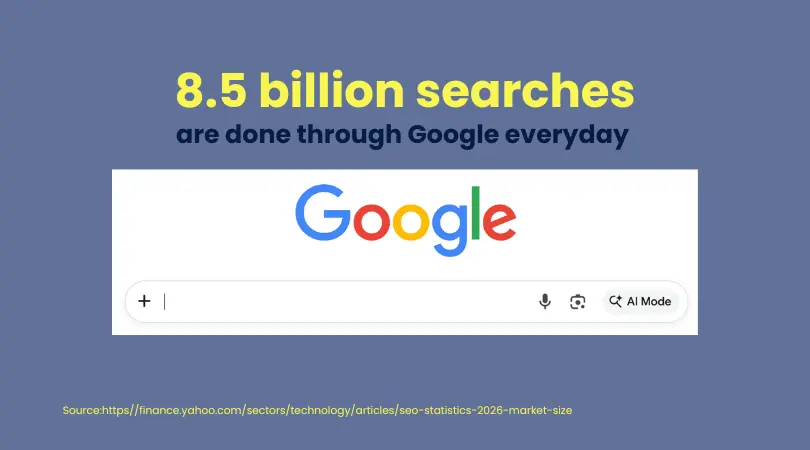
Search is one of the most powerful drivers of high-intent traffic, and for many businesses, it’s where the most valuable buyers begin their journey.
With 2.6 billion people shopping online, your visibility in search results directly impacts your ability to generate demand, capture interest, and drive consistent growth.
Your search engine rankings are impacted by your search engine optimisation (SEO) strategy. This focuses on:
- Number of ranking-targeted keywords: This indicates whether your business is appearing for the specific terms your ideal customers are actively searching for.
- Volume of organic traffic: This indicates how effectively your rankings are translating into real, relevant website visits.
- Number of backlinks: This is a key signal of authority that strengthens your ability to rank and builds long-term credibility in your market.
Together, these metrics provide a much clearer picture of SEO performance that can help you adjust your strategies to drive growth.
Click-through rate (CTR)
Ranking in search is only part of the equation. What really matters is whether people are choosing to click on your result.
CTR measures how often users click on your link after seeing it in search results. It’s a strong indicator of how compelling and relevant your listing is, from your page title and meta description to how well your platform matches search intent.
The average CTR for search sits around 6.6%, but high-performing teams know that this number on its own means very little. Every business has its own baseline, which is determined by looking at:
- Industry benchmarks.
- Historical performance data.
- Campaign objectives.
- Audience behaviour.
This context matters. A branded search term will naturally have a higher CTR than a competitive, non-branded keyword.
Rather than chasing a universal benchmark, focus on continuous improvement by refining your messaging, testing variations, and aligning content more closely with what your audience is searching for.
Cost-per-click (CPC) and customer acquisition cost (CAC)
Cost metrics, like cost-per-click (CPC) and customer acquisition costs (CAC), help leaders determine if their growth is sustainable.
CPC measures how much you’re paying to bring someone to your site through paid channels, while CAC looks at the total cost of acquiring a new customer.
Together, these metrics ensure that marketing efforts remain commercially viable. They indicate where spending is efficient, where it’s being wasted, and whether current strategies can scale without negatively impacting profitability.
Tools and Platforms to Track the Right Metrics
Analytics tools
Analytics tools can help you track everything from website traffic and user behaviour to conversions and campaign performance.
They help you understand where your audience is coming from, how they’re interacting with your content, and where they’re dropping off. This means you can:
- Analysing user journeys beyond page views.
- Tracking conversion paths.
- Segmenting audiences to understand behaviour patterns.
The goal is to use the data you collect to uncover insights that inform smarter decisions and sharper strategies.
Automation and AI
As marketing becomes more complex, manual tracking is difficult to scale.
This is where automation and AI can streamline data collection, improve accuracy, and surface insights faster than manual processing. You can use these tools to:
- Automate reporting, saving time and reducing human error.
- Identify trends and anomalies in real-time.
- Predict performance and optimise campaigns proactively.
Integrating with CRM systems
If your marketing data and sales data live in separate systems, you’re only seeing half the picture. That’s why integration with a CRM system is key.
A well-integrated CRM connects your marketing efforts directly to revenue outcomes. It allows you to track the full customer journey and measure what’s actually driving your conversions.
This is where metrics like lead-to-customer rates, CAC, and customer lifetime value become more accurate and meaningful in aligning your marketing efforts.
Make Your Marketing Work Harder with Barrk
The difference between average marketing and high-performance campaigns is just where you’re focused.
When you’re measuring the right metrics, everything becomes clearer. But when you track the wrong metrics, even the best campaigns can lead you in the wrong direction.
That’s where the Barrk team comes in. We help you measure what matters most so that your marketing is smarter and works harder. Get in touch with us to learn more!