
Why Good Traffic Leaves Your Site in Seconds

Most websites are built like a book, and when you read them in order, they make perfect sense. The problem is that almost nobody reads it in order anymore.
Your buyers arrive deep inside your site, on pages you barely think about, with no idea who you are and no patience to find out.
Now, one page has to do everything: explain what you do, prove you’re any good, and give them a reason to stay. The reality is that most pages can’t keep up.
In this article, we cover why that’s happening and what to change on the pages already doing the heavy lifting.
The Shattered Front Door Problem
Picture your last few searches. How many started on your company website’s home page? Probably the minority.
Today, buyers tend to land wherever their search query leads. An AI assistant can drop them straight onto a pricing page, or a shared link could send them to a case study.
This means they often never see your home page and the careful navigation you built to lead them from who you are to purchasing your product.
The shift is bigger than most businesses realise. Research from SparkToro and Datos found that out of every 1,000 Google searches, only 360 end in a click-through to a website. Many of the rest are answered on the search page itself or inside an AI summary.
When people do click through from an AI tool, they’re also not browsing. They’re already making decisions. Semrush’s 2025 data shows that AI-driven visitors convert at 4.4 times the rate of standard organic search traffic across industries.
These buyers arrive with a specific question and a short attention span. If your page doesn’t answer that query in seconds, they won’t dig for it elsewhere on your site.
Instead, they click out and ask the AI tool again.
Three Ways a Deep Page Loses the Visitor
If a visitor lands on a web page, it has a few seconds to answer their questions. Here’s how most pages lose them in that time.
1. Talking about you, not their problem
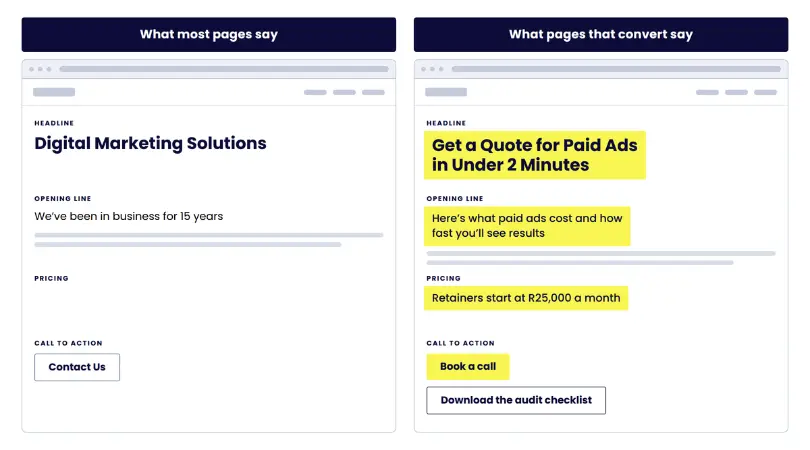
Many pages open with the company’s stories: “We’ve been in business for 15 years” or “We pride ourselves on quality.”
While this might be true, none of it answers why the visitor clicked on your site in the first place.
They came with a question. If a page doesn’t speak to that question in the first few lines, they assume the answer isn’t there and move on.
2. Missing prices
Buyers want to know if they’re in the right range before they commit any time. If a page hides pricing behind contact pages or requests, many visitors might not want to bother.
They’ll go find a competitor who tells them straight away, even if the number is only a rough guide.
3. Unclear next steps
Not every visitor is ready to book a call. Some just want more detail or to compare their options. If the only choice on your page is to speak to sales, visitors who aren’t ready yet have nowhere to go.
This means they leave instead of taking a smaller step forward, and you lose a good buyer.
What Your Webpage Needs to Survive on Its Own
If a page has to work alone, it needs a few things built in from the start. Here’s what to check for on your next website audit.
A headline that names the problem
Run this test on any page of your site the next time you check it: Cover everything except for the headline and the first sentence.
Ask yourself if a stranger could tell you what the page is about, who it’s for, and what it costs to find out more. If not, the page is failing its first job.
Most headlines fail because they name the category or department instead of the problem or solution.
For example, a headline like “Digital Marketing Solutions” is the category, but “Get a Quote for Paid Ads in Under 2 Minutes” tells them exactly what they’ll get and how fast.
Visitors who aren’t looking for this service leave fast, which saves everyone time. But visitors who are looking read on and move further down the funnel.
Pricing context in the first screen
Most businesses skip pricing because their work is custom. That’s a fair reason to avoid a fixed number, but it’s not always a reason to say nothing.
You have four options, and almost every business can use at least one:
- A starting point: “Retainers start at R25,000 a month.”
- A range with a reason: “Most projects land between R20,000 and R80,000 depending on how many pages need rebuilding.”
- The price drivers: List three or four things that move the number up or down. This teaches the buyer how you think, which is its own kind of proof.
- A worked example: “A 20-page site for a company with two service lines typically takes six weeks and costs around X.”
The point isn’t accuracy; it’s qualification. A visitor who can’t work out whether they can afford you will either assume they can’t or book a call to find out and waste an hour of both your time. Both outcomes are worse than just telling them upfront.
One main action (and an easy alternative)
Unbounce’s analysis of 41,000 landing pages found that only 6.6% of 464 million visitors are converted into sales. That means 93 out of 100 visitors leave with nothing because most website pages aren’t built for them.
This is where you need to give them somewhere to go. One main action and one low-commitment alternative for people who aren’t ready.
This could be a guide, calculator, a short assessment or even a newsletter. Keep the form to three fields max to avoid additional drop-off rates.
Structure that AI tools can quote
If AI assistants are sending you traffic, it’s worth understanding what makes them cite you in the first place.
Typically, they look for pages that answer a question clearly and can be quoted without ambiguity. In practice, that means:
- Ask the question in a heading, then answer it in the first two sentences underneath. You don’t need to build up to it.
- Use specific numbers, dates, and names rather than words like “many” or “recently”. Vague claims are hard to quote and easy to skip.
- Add FAQ and Service Schema markups so the page structure is machine-readable.
- Keep the answer on the page. If the real substance sits inside a gated PDF, nothing can cite it, and no one can read it.
Put It Into Practice
You don’t need to rebuild your whole site. You just need to find the pages that are already acting as entry points and fix those first.
Measure entry pages, not sessions
Sitewide numbers often hide the problem. Total sessions and average bounce rate lump visitors who arrived on your home page with those who landed on a cold service page into the same box. In reality, they are nothing alike.
Look at entry pages instead. In Google Analytics (GA) 4, go to Reports, then Engagement, then Landing page, then sort by sessions.
Every session starts on one page, so this shows you exactly which pages are making your first impressions. Most businesses find a few pages they barely thought about do most of that work.
Then check where those visitors came from. GA4 added an AI Assistant channel in mid 2026, so open Reports, then Acquisition, then Traffic acquisition, and look for it.
It covers ChatGPT, Gemini, Copilot and a few others, but not Perplexity, which still shows up under Referral or Direct.
If Perplexity matters to you, build a custom channel group in Admin under Data display to pull them together.
Start with pages that get the most visits
Take the entry page list and pick the five that receive the most first visits. Run each through the five checks we mentioned earlier:
- Does the headline name a problem a stranger would recognise?
- Is there a pricing signal in the first screen?
- Are there links across to related pages in the body text?
- Is there one clear action plus one lighter option?
- Could an AI tool lift a clean answer from this page?
Most pages fail two or three. Fix those, leave the page alone for a month, then check what happened to its entry conversion rate.
This is slow, unglamorous work, but it’s the cheapest growth available to most businesses. You keep the traffic you already paid for instead of buying more.
Make Every Page Work Hard with Barrk
You can’t control where buyers land on your site any more. But you can control what they find when they get there.
For businesses that rely on quality leads rather than sheer volume, that difference adds up quickly. Every visitor who arrives on a page that answers their question stays. Every one who lands on a page that talks about you instead is a lead your competitor gets to keep.
When you partner with Barrk, you don’t have to figure this out on your own.
As your marketing partner, we help you build pages that stand on their own and answer real questions, turning visitors into confident buyers.
Reach out to us today to see how we can help!