
The Hidden Ad Spend Leaks Draining Your Marketing Budget

Your advertising campaigns can be busy without being effective.
Clicks may be climbing, impressions could be stacking up, and new leads may even appear in your dashboard.
But when those numbers fail to translate into qualified opportunities, part of your budget may be quietly going to waste. In fact, experts say that up to 30% of your ad spend could be a waste of money.
Before increasing your spend, it’s worth checking whether your current campaigns are really working and producing the results you actually want.
Let’s dive into where ad spend commonly goes to waste and how a practical marketing audit can help you plug the leaks.
Where Does Ad Spend Actually Go to Waste
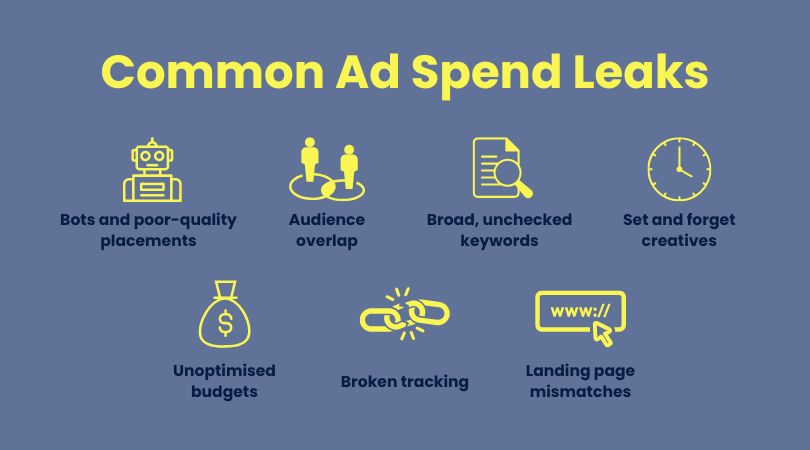
1. Bot traffic and poor-quality placements
Your ads may be receiving clicks, but the important question is whether there’s an actual human behind them.
Bot traffic includes automated programmes designed to imitate genuine online behaviour, including generating activity on your ads. Other forms of poor-quality delivery include:
- Accidental clicks.
- Ads that were served but barely visible.
- Placements on websites created primarily to generate ad revenue.
Warning signs of this type of ad waste can include:
- Sudden spikes in clicks without a corresponding increase in inquiries.
- Traffic coming from countries you don’t serve.
- Placements producing high CTRs and no website engagement.
- Repeated form submissions with false or suspicious information.
This doesn’t mean every unusual click is fraudulent. But it does mean placement quality, location data and downstream behaviour deserve more regular reviews.
2. Audience overlap between campaigns
Audience overlap happens when several campaigns target the same group of people.
A prospect may sit inside your awareness, remarketing, and customer-list audiences at the same time. Add multiple platforms to the mix, and the same person could be seeing your ads repeatedly across them.
While some repetition is useful, too much can increase costs. This inflates frequency and makes attribution messy.
Give each campaign a clear role and use exclusions to separate prospecting, remarketing, retention, and customer campaigns.
3. Broad match keywords running unchecked
Broad match keywords can expand your reach beyond the exact searches in your keyword list. When paired with accurate conversion tracking and a conversion-focused Smart Bidding strategy, they give Google more relevant auctions to evaluate and can perform strongly.
Problems arise when broad match is used without those controls. A B2B campaign may start appearing for searches about free tools, courses, jobs, definitions or services the business does not offer.
A well-maintained negative keyword list helps block clearly irrelevant themes, while regular search-term reviews reveal new queries that need attention.
The goal is not to restrict every search. It’s to give Smart Bidding enough room to find valuable demand without paying for traffic that was never likely to convert.
4. “Set and forget” creatives
Advertising creative has a shelf life, especially for a smaller target audience.
When the same audience sees the same advert repeatedly, attention drops and costs often rise. Common signs include:
- Declining click-through rates.
- Rising frequency.
- Increasing cost per result.
- Fewer conversions from the same level of spend.
Creative reviews should test meaningful changes, such as new customer problems, benefits, formats, offers and calls to action.
Fresh artwork alone will not solve a weak campaign. Sometimes the audience is tired of the advert. Sometimes the advert was never especially interesting.
5. Budgets optimised for vanity metrics
Advertising platforms are good at finding more of whatever you ask for.
Optimise for clicks, and you will probably get clicks. Optimise for cheap form submissions, and you may get plenty of people who never become customers.
The problem begins when convenient platform metrics become substitutes for business performance.
So while impressions, reach, views, and clicks can help you understand your audience response, they don’t automatically mean that the campaign is profitable.
Healthy campaign performance should eventually connect to more commercial outcomes, such as:
- Qualified leads.
- New opportunities.
- Customer acquisition cost.
- Pipeline and revenue.
Cheap activity is only a bargain when it contributes to something useful.
6. Broken or disconnected tracking
Poor tracking can hide good performance, exaggerate weak results or send budget towards the wrong campaign.
Common problems include:
- Missing UTM parameters.
- Duplicate conversion events.
- Untracked calls.
- Leads that can’t be matched to CRM records.
Each platform dashboard shows one part of the journey. Their totals cannot simply be added together.
Where possible, advertising data should connect to website analytics, CRM lead stages, opportunities and revenue.
7. Mismatches between ads and landing pages
Sometimes the targeting is right, and the advert does its job. Then the landing page lets the whole side down.
Visitors may find a generic homepage, a slow mobile experience, an unclear offer or a form that asks for far too much information.
The landing page should continue the conversation started by the advert. The message, audience, offer and call to action should all align.
When traffic is strong, but conversions are weak, increasing the budget is rarely the answer. Sending more people into a confusing journey simply helps the money leak faster.
Why is Ad Waste so Difficult to Spot?
Ad waste often hides inside activity that looks positive. Clicks, impressions and leads can make a campaign seem healthy, even when the traffic is poor, the audience is wrong, or the leads never convert.
It’s also spread across different platforms, tools and teams.
Google, Meta, LinkedIn analytics and CRM systems may all report performance differently, making it difficult to see the full picture.
Without regular checks, small leaks can quietly continue for months. The dashboards stay busy. The budget keeps moving. The real business impact remains unclear.
How Does a Marketing Audit Help?
A marketing audit brings all the moving parts into one view. It helps you see where money is going, what is driving genuine results and which areas need attention.
Done properly, it turns a messy collection of campaigns, platforms and reports into a clear action plan.
Your simple 5-step ad waste audit
1. Identify clear goals
Start by defining what each campaign is meant to achieve. For example, ask yourself questions like:
- Is the goal awareness, leads, sales, bookings or pipeline?
- Which action matters most, and how will you know whether the campaign has succeeded?
Clear goals make it easier to separate useful activity from expensive noise.
2. Take an inventory of your paid media ecosystem
List every platform, campaign, audience, keyword group, creative asset, landing page and tracking tool currently in use.
Include your analytics platform, CRM, reporting dashboards and any external partners involved. This helps you spot duplication, gaps and areas where ownership is unclear.
3. Analyse what’s actually happening
Compare platform data with website behaviour, CRM records and sales outcomes.
Look beyond impressions and clicks. Review lead quality, conversion rates, placement performance, search terms, audience frequency and revenue where possible.
The aim is to understand what is happening after the budget is spent.
4. Ensure everything aligns
Check whether the platform, audience, advert, landing page and conversion goal all support the same objective.
Ask whether the message matches the buyer’s needs, whether the journey makes sense and whether marketing and sales agree on what a valuable lead looks like.
Misalignment is one of the easiest ways for budget to leak.
5. Prioritise action points
You don’t need to fix everything at once.
Start with clear waste, broken tracking and obvious targeting issues. Then move on to areas that need testing, such as new creative, revised audiences or a different budget split.
A useful audit should leave you with a focused list of what to stop, fix, test and scale.
How Can Marketing Audits Help Optimise Ad Spend?
With regular marketing audits that identify problem areas, you can better direct your budget towards the channels, campaigns and activities most likely to deliver meaningful business results.
It is not simply about cutting costs or chasing the cheapest lead.
Rather, it’s about understanding what is working, removing proven waste and investing more confidently in the areas that support your goals. This could mean:
- Moving budget away from poor-performing campaigns.
- Improving targeting and exclusions.
- Refreshing tired creative.
- Fixing broken tracking.
- Strengthening landing pages.
- Investing more in channels that produce qualified leads or revenue.
Good optimisation balances performance with learning. Some budget should support proven ad activity, while a smaller portion can be used to test new ideas, audiences and platforms.
The goal is simple: smarter, harder-working marketing that gives you more confidence in how your money is being spent.
Plug the Leaks Before Increasing the Flow
Adding more budget to a leaky marketing system only gives waste more room to grow.
Before simply increasing your spend, a focused audit can reveal more about where your money is being lost and what needs to change first.
The Barrk team is ready to help you refocus your ad strategy to help your budget work harder to target the people you actually want to reach.
Get in touch with us today to see how we can help!