
Planning Your 2027 Marketing Budget? Start With What Didn’t Work in 2026

Most marketing budgets start the same way. Someone opens last year’s spreadsheet, adds a few rands, and calls it a plan.
It’s quick and tidy, but it also carries every one of 2026’s mistakes straight into 2027.
If you’re planning your 2027 marketing budget right now, start somewhere less comfortable: with what didn’t work.
Whether that’s the campaign that ate the budget and gave back very little or the tool nobody has logged into since March.
This blog covers everything you need to know to maximise your budget in 2027, plus a few practical ways Barrk can help. Let’s dive in!
First, Let’s Find the Moneymakers
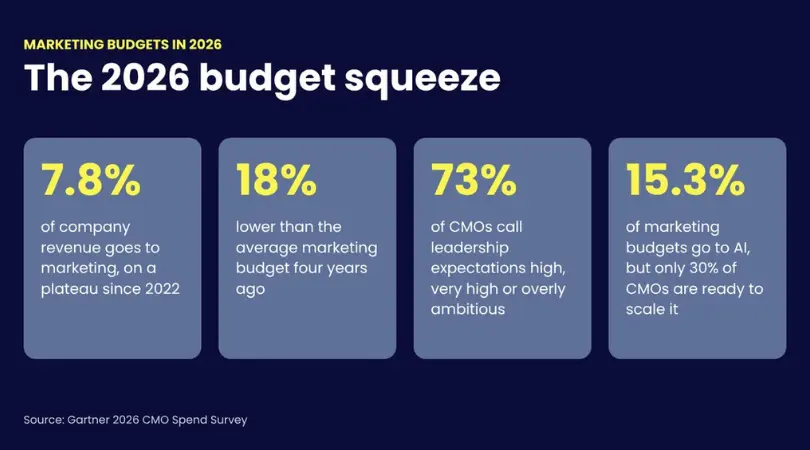
The reality is that most marketing teams won’t get a bigger slice of the pie. Gartner’s 2026 CMO Spend Survey found that marketing budgets average only 7.8% of company revenue.
That number has barely moved since 2022 and now represents 18% less than the average budget four years ago.
Pressure on marketing teams also hasn’t eased. 73% of CMOs describe leadership expectations as too high or overly ambitious. Fewer CMOs also report beating their targets on acquisition, retention, and ROI.
So essentially, you’re being asked for more growth with the same money, while also figuring out AI tools.
The advice to CMOs is blunt:
– Pressure-test every investment.
– Cut low-value legacy.
– Make deliberate cuts.
In other words: the fastest way to fund 2027 is to stop paying for what didn’t work in 2026.
Five Places Where Your Budget May Have Leaked
Every business is different, but these five leaks are some of the most common and the most expensive to ignore.
1. Tools you pay for but barely use
Martech is sneaky. Each subscription looks small, but together, they can add up fast.
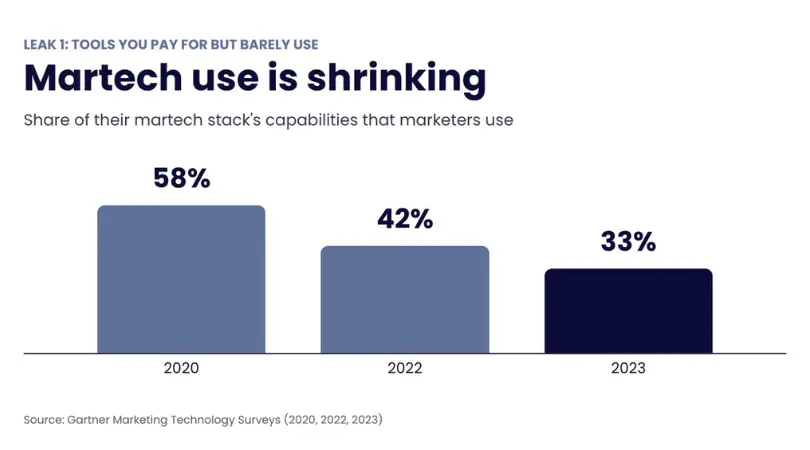
Research shows that marketers spent almost a quarter of their budgets on technology in 2022. Yet in 2023, they used only 33% of these tools’ capacity.
That’s down from 42% in 2022 and 58% in 2020.
The top reasons for this include:
– Tools that overlap.
– A lack of skilled people to run them.
– Stacks that have simply grown too complex.
When you set up your budget for 2027, ask yourself: For every tool that you paid for in 2026, who owns it, when was it last used, and what decisions does it help you make?
If you can’t answer, cut it. If two tools do the same job, keep one; if a tool is good but unused, budget for training before buying anything new.
2. Spend that only chased people ready to buy today
Search ads, retargeting, and “book a demo” campaigns feel safe. They are easy to track and often get credit for the sale.
But research by the Ehrenberg-Bass Institute suggests that only about 5% of B2B buyers are in the market. The other 95% won’t buy for months.
If most of your 2026 budget went to the 5%, you fought hard over a small group and were invisible to everyone who will be ready to buy in 2027.
Gartner flags the same risk. In 2026, CMOs moved money towards paid media and customer acquisition. But Gartner warns that this may boost short-term results while weakening long-term growth.
Look back at where your 2026 money went:
– Which one did leadership actually use to make a decision?
– How many of the numbers in it linked back to revenue?
If the first number is small and the second hasn’t moved, you’ve found a leak.
In 2027, protect a steady share of your budget for reach and thought leadership. This kind of spend pays off over quarters, not weeks, so judge it that way.
3. Leads that went cold between marketing and sales
Many buyers do most of the work alone. The Gartner study found that 67% of B2B buyers prefer to buy without speaking to a sales rep and 45% used AI during a recent purchase.
By the time someone fills in your form, they’ve done their homework. A slow reply or a generic follow-up wastes the most expensive part of your funnel.
If your funnel has holes, throwing more budget at it doubles your waste.
Start by checking how quickly your 2026 leads heard back from you. Then look at how many proposals were rejected and why.
Often you’ll find that marketing and sales don’t agree on what a good lead looks like in the first place.
That’s where the real fix starts. Get both teams to agree on one lead definition, response time, and way to share feedback.
Plug those gaps first, and only then pay for more leads.
4. Reports that counted activity, not outcomes
Impressions, followers and clicks are easy to report. They look great on a slide, but they can rarely answer what you got for the money.
There’s a second problem too. Some of your best results are hard to see.
When people share your content in WhatsApp groups, emails or DMs, most tools can’t track it.
That’s called dark social, and it often shows up as “direct” traffic. So the last-click channel gets all the credit.
Gartner advises CMOs to measure the full funnel, not just the last click.
Think about the 2026 reports that crossed your desk:
– Which one did leadership actually use to make a decision?
– How many of the numbers in it linked back to revenue?
For 2027, choose a short list of numbers that tie to business goals and report on those.
Add a simple “How did you hear about us?” field to your forms to catch what the tools miss. Then step back once a quarter and look at the full picture, not just the last click.
5. AI experiments with no plan
AI was the big budget story of 2026. In fact, studies found that CMOs put 15.3% of their budgets into AI. Yet only 30% say they’re ready to scale it.
This means many teams are stuck running pilots that never grow up. That’s not a reason to pull back from AI, but it is a reason to be more selective.
Take stock of your 2026 AI projects and ask yourself which ones saved time or money you can actually measure. Then determine which have quietly become just another subscription.
In 2027, fund fewer AI uses, but back them properly. Give each one a clear outcome, an owner and a deadline to prove itself.
Gartner points the same way: get your data, processes and governance right first, rather than spreading money across scattered tools and one-off pilots.
How to Run Your 2026 Budget Audit in One Afternoon
You don’t need a consultant or a three-week audit to start. You need a spreadsheet, honest answers and a few hours with the people who spent the money.
Here’s how:
1. List every line item: List every channel, tool, agency, campaign and freelancer you paid for in 2026, with the cost in rand.
2. Write down the job it was hired to do: Was it more leads? Lower cost per sale? Brand awareness in a new market? Write just one line for each.
3. Add the evidence: What did it actually deliver? Use real numbers, and if there are none, write “no evidence”. That’s an answer too.
4. Sort each item into one of four boxes: Keep, Fix, Cut or Test (more on these below).
5. Move the money: Let what you cut pay for what you fix and test, before you ask for anything new.
6. Write down why: Have a short reason for every decision. This becomes your budget story for the board.
Once you get to step four, sort your items into the boxes below:
1. Keep: It worked, you can prove it, and it ties to a 2027 goal. You can continue funding it with confidence.
2. Fix: The idea was right, but something got in the way. Think good leads with slow follow-up, or a strong campaign with a weak landing page. Fix the problem before you add more money.
3. Cut: This has no owner, no evidence, or no link to a business goal. Be honest and cut what you don’t need because this is where your 2027 money lives.
4. Test: Take a small bet on something new. Give it a clear success measure and a review date, so it can’t quietly become next year’s leak.
Make Your Budget Work Harder with Barrk
Here’s the thing about “what didn’t work”: It’s only a failure if you pay for it twice.
The teams that win in 2027 will be the ones who looked hard at 2026, cut what wasn’t pulling its weight, and moved that money to where it can grow.
We want to help your budget work harder so you can win 2027. That’s why every Barrk client works with a digital strategist, not a task coordinator.
This person asks the awkward questions, reads the data with you, and has the authority to change the plan when something isn’t working. Book a free budgeting session with us today!